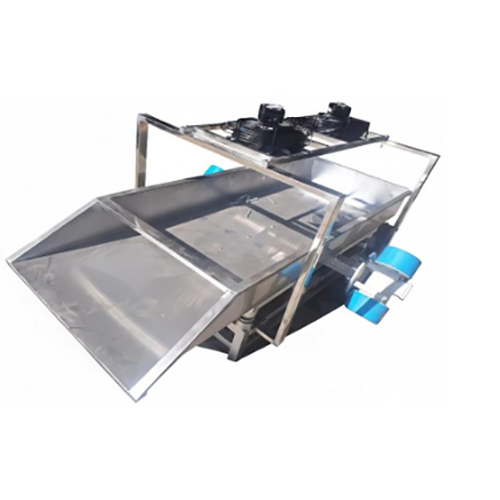
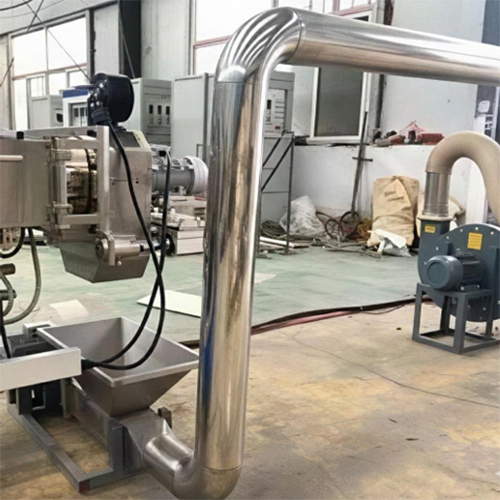
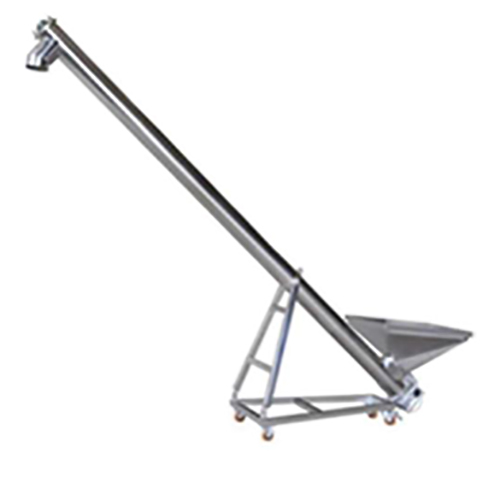
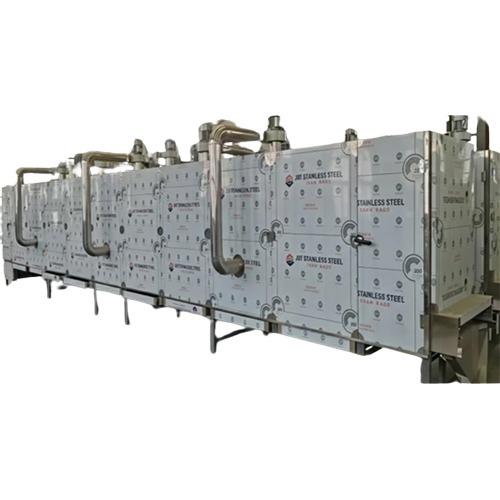
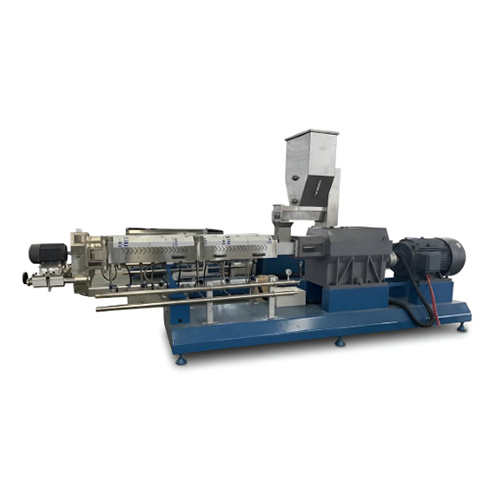
About Viberator Feeder
- Total power : 6.22 KW
- Motor power : 0.11kw*2
- Fan power : 3kw*2
- Dimension(m) : 4.5x1.4x0.7
Vibratory feeder makes sure that rice go into cooler machine evenly.
- Remove the product not in demanded size by vibration.
- Make sure the fortified rice will not stick together
- Food contact part is stainless Steel
High-Efficiency Material FeedingThe Vibrator Feeder with Lubrication offers over 95% efficiency in material transfer, allowing for precise bulk handling and consistent flow. Designed with an adjustable feed rate and vibration amplitude, it ensures tailored feeding suitable for different materials. Its low power consumption and robust construction make it ideal for continuous-duty operations in demanding industrial settings.
Long-Lasting and Low MaintenanceFitted with self-lubricating bearings and a stainless steel feeding tray, this feeder is built for durability and extended service life. The powder-coated mild steel body resists corrosion and wear, while low maintenance requirements reduce operational downtime. Overload protection and stable base design add to its reliable performance.
Versatile Applications and User-Friendly OperationWhether used in mining, food processing, cement, or metallurgy, the automatic vibrator feeder adapts seamlessly to varied material types. Easily installable with bolted, base-mounted design, and equipped with an intuitive control panel, it supports both on-site and remote technical support, offering significant flexibility and ease of integration.
FAQ's of Viberator Feeder:
Q: How does the Vibrator Feeder with Lubrication operate and feed materials?
A: The Vibrator Feeder uses a vibratory motor to create controlled vibrations, moving material through a stainless steel tray or trough. Feed rates and vibration amplitudes can be easily adjusted via the controller to suit specific material and process requirements.
Q: What kind of maintenance is required for the feeder, and how does lubrication work?
A: Minimal maintenance is necessary due to self-lubricating bearings. Regular checks on the tray surface and periodic inspections of the vibratory motor and controller are recommended to ensure optimal performance and longevity.
Q: When should vibration amplitude and feed rate adjustments be made?
A: Adjustments to amplitude and feed rate should be made when handling different materials or when changing process requirements, ensuring precise and consistent feeding according to specific production needs.
Q: Where can this Vibrator Feeder be installed, and what are common usage scenarios?
A: It is suitable for installation in mining, metallurgy, quarries, cement plants, and food processing facilities. The base-mounted, bolted design enables stable positioning on foundations or structures as required by the operation site.
Q: What are the primary benefits of using this Vibrator Feeder?
A: Primary benefits include high feeding efficiency, low noise, low power consumption, long operational life, low maintenance, easy operation, and precise feed control, making it a cost-effective and reliable solution for bulk material handling.
Q: How does the feeder ensure safety and environmental protection during operation?
A: The system is equipped with overload protection and a stable base for operational safety. For enhanced environmental protection, a dust cover is available on request, minimizing dust release during material transfer.